

Before Columbus landed in the Americas in 1492, the number of Native Americans across the continent was somewhere between 5 and 15 million. The subsequent waves of European conquerors, profiteers, and settlers brought 400 years of war, disease, genocide, forced marches, reservations, and thousands of broken treaties. By 1890, the Native American population had fallen to 250,000 and was almost lost forever. Today, that population has grown back to over 5 million, but it remains the poorest group in the United States. Life on many reservations remains burdened by limited infrastructure, poor housing, high unemployment, and short life expectancies. And shockingly, much Native American land is still controlled “in trust” by the Bureau of Indian Affairs, one of the most incompetent bureaucracies in the federal government.
If you believe in reparations, there would be no better starting place than returning Native American land to its original tribes. Until then, perhaps the best we can do is support the small but impressive community development financial institutions (CDFIs) serving Native Americans. One of the newest is Turtle Island Community Capital, which focuses on Native businesses and projects in the Northeast and Mid-Atlantic states.
This week, we’re pleased to interview the founder of Turtle Island, Alexander “Brave Journey” Sterling. With ancestral roots in the Ramapo Lenape Nation, Cuba, and the African diaspora, and a deep commitment to relational finance, Alexander brings two decades of experience in clean energy, community development, and impact investing. His work is impressive, and if you know any impact investors looking for a great new fund, please direct them to Turtle Island.
— Michael H. Shuman, Publisher
Publication of The Main Street Journal depends on your support. If you like what you’re reading, please become a paid subscriber today. You’ll enjoy special events like our monthly “Mondays with Michael.” If you can afford to send a gift, better still!
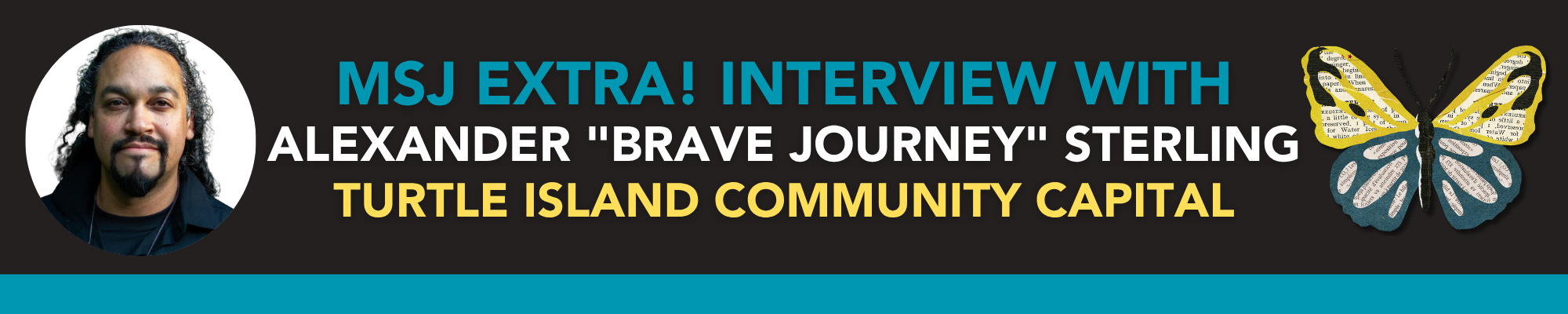
MS: Before we discuss your fund, Turtle Island Community Capital (TICC), I want to ask you about your nickname “Brave Journey.” Where did it originate, and how does it connect with the professional evolution that took you to TICC?
AS: Thank you, and that’s not a nickname, it’s my traditional name, which some people would say is my Indian name. It was given to me when I was very young, and it’s just been a part of who I am and how I see the world. “Brave Journey” is a name that reflects both path and responsibility. In many Indigenous traditions, names aren’t just identifiers; they’re reminders of who you’re becoming and what you’re accountable to, and hoooo boy has this one carried weight.
For me, it speaks to a willingness to move into uncertainty with intention. My career hasn’t followed a straight line in any sense, and much of it was developed through intention and courage in times of uncertainty. It’s moved through art, construction, energy, community development, and finance. At each step, I’ve had to learn, adapt, and stay grounded in the idea that the work is ultimately about people.
TICC is a continuation of that journey. It’s about building something that hasn’t existed here in the region… ever. We’re building financial systems that are aligned with community, culture, and long-term wellbeing. That requires courage, but also humility and listening.
MS: Your previous career role was running a private consulting firm in San Francisco and supporting renewable energy projects in tribal, rural, and urban communities. Tell us a little about that work. What were some of the projects that you helped get off the ground?
AS: That work really grew out of a career that’s been intentionally cross-disciplinary and what we now call multi-hyphenate, spanning tech, construction, solar, music and event production, film, hospitality, and large-scale community builds like Burning Man. I started in live production and fabrication by running sound, lighting, and stage systems, building sets, and managing crews to create functional, immersive environments under tight timelines. At the same time, I was doing construction and custom fabrication work, which grounded me in materials, logistics, and problem-solving.
I carried those skills into renewable energy and tech. In solar construction, I managed installations, permitting, and supply chains. Later, at a solar technology company, I helped build testing and reliability operations by developing systems, managing teams, and scaling processes across engineering and operations. Alongside that, I stayed deeply engaged in community-based work in organizing large-scale builds, supporting food systems, and creating shared spaces.
So when I moved into this work, I wasn’t just bringing technical expertise; I was bringing systems thinking shaped by real-world experience. That allowed me to support projects holistically, especially in tribal communities, where success depends as much on trust and adaptability as it does on technology.
MS: I just completed a study on solar energy for the City of Irvine, and came to the conclusion that the combination of rising utility rates and falling solar equipment costs is now making decentralized rooftop solar with batteries the most economical means of providing communities with electricity. Given that many tribal reservations have very limited transmission and distribution infrastructure, decentralized solar seems especially promising in Indian Country. Do you agree?
AS: I do, and I think we’re already seeing that play out in real time with the federal clawbacks from Greenhouse Gas Reduction Fund and Solar for All funding, and grid failures during major climate events. Decentralized solar, especially when paired with battery storage, is becoming one of the most practical and cost-effective ways to deliver energy, particularly in communities where grid infrastructure is limited, aging, or expensive to expand. Surprising no one, tribal communities are those communities.
In many tribal communities, extending traditional transmission systems can be cost-prohibitive and slow. Decentralized systems allow communities to build resilience more quickly, reduce long-term energy costs, and increase local control over how energy is produced and used. But the real opportunity goes beyond the simple access to technology. When these systems are community-owned or locally managed, they become a foundation for economic development by creating jobs, building technical capacity, and keeping more value within the community.
So yes, decentralized energy is a powerful tool, but its full potential is realized when it’s paired with ownership, workforce development, and access to capital that allows communities to lead these projects themselves.
MS: Your website says that TICC is “a Native-led community development financial institution dedicated to advanced economic sovereignty, generational wealth, and community resilience in Indigenous and historically excluded communities.” What are the projects and businesses you are funding that fall into these categories?
AS: We focus on three interconnected areas that we see as foundational to healthy and thriving communities. The first is basic needs: projects that support food and water sovereignty broadly. That includes small-scale agriculture, food distribution, and infrastructure that ensures communities have reliable access to essential resources. Plus blue-green economy work supporting living shorelines, fishing, and supply chain connections.
The second is access to community: This is an infrastructure commitment to things like energy systems and connectivity. Clean energy projects are a major part of this, especially where they can reduce costs and increase local control.
The third is what we call “reasons for living,” and it’s one that’s near and dear to my former fine art studio major heart: arts, culture, and small businesses that create vibrancy, identity, and opportunity within a community. Music, Fashion, Venues, LIFE!
Across all of these categories, we provide flexible capital by often blending grants with low-cost loans, staging them to be most supportive to the entrepreneur or community, and pairing that with technical assistance. The goal is not just to fund projects, but to ensure they succeed and can grow over time. We’re really focused on building the conditions for long-term economic sovereignty, rather than just supporting one-off investments.
MS: The geographic focus of your fund is the Northeast and Mid-Atlantic states. Why did you choose this area?
AS: Every time I’m asked this question, I’m reminded of the Guardians of the Galaxy quote where Star-Lord gets asked why he wants to save all the idiots in the system, and he responds: “Because I’m one of the idiots who lives in it!”
This region is home to me, and it’s also a place where Native communities have deep historical roots that are often overlooked. My own tribe is based historically and currently in the NY-NJ-CT corner and is among the earliest denizens of Lenapehokiing, now known as New York City.
There’s a strong presence of Indigenous communities across the Northeast and Mid-Atlantic, but relatively limited financial infrastructure designed specifically to support them. At the same time, the region has significant economic activity and access to capital that creates a gap—and an opportunity.
We chose to focus here because we believe regional institutions matter. Being grounded in place allows us to build relationships, understand local contexts, and support projects in a more meaningful and responsive way. But it also allows us to connect communities that are often working in isolation and help build a stronger, more coordinated ecosystem.
Over time, the goal is to demonstrate a model that can be replicated in other regions, but it starts with building something that works deeply and authentically in one place.
MS: Oweesta and other CDFIs have been serving Native American needs for several years. How do you see TICC as carrying out—or differing from—the kind of work they have been doing?
AS: We see ourselves as part of a broader ecosystem and deeply respect the work that organizations like Oweesta have done to build the foundation for Native CDFIs, including us. Oweesta has been an enormous support in helping us get started, as have several non native CDFIs in our region, like Boston Impact Initiative and Nectar Community Investments.
Our approach builds on that foundation while focusing on a few key areas. One is how we structure capital and our target deployment. We intentionally blend grants, recoverable capital, and low-cost debt to meet communities where they are and reduce the burden on borrowers. We’re building directly into entrepreneurship communities instead of intermediate lending to other CDFIs. While I would love to help spawn a dozen other Native CDFI-type institutions here for each tribal community, that’s not where we are capacity-wise, and I’m grateful for the organizations that have been around to build those systems.
We also place a strong emphasis on relationship-building through programs like Native Impact Nights and Resilience Circles. We’ve found that capital moves more effectively when it’s grounded in trust and community connection, and that the methodology for building that trust is most effective when we really get to the table together.
So while we share a common mission, our role is to help expand the field by bringing new tools, regional focus, and integrated approaches to how capital supports Native communities.
MS: Your website has the numbers 38, 610,000, 7, and 96 highlighted: 38 entrepreneurs supported, $610,000 in capital raised, 7 convenings, and 96 hours of technical assistance provided. What’s your target for capital raising this coming year? What kind of capital will you provide to Native entrepreneurs, and what size will your investments be?
AS: We’re currently working toward raising 8 million dollars in catalytic capital to support our next phase of growth (our Watershed Capital Fund), with a longer-term goal of building a $30 million regional fund (the First Fires Fund) in 2027.
Our approach is to provide flexible, accessible capital that aligns with community needs. That often includes small business loans in the tens of thousands of dollars, alongside larger project financing as we scale. Since we also focus heavily on how capital is structured, we aim to keep costs low for borrowers and pair financing with technical assistance so projects are set up for long-term success by raising grant funding to cover operations and employing fee-for-service in other areas of consulting and contracting while we build towards self-sufficiency.
In many cases, for our investments, we’re blending capital by combining grants with low-cost debt to reduce risk and increase accessibility.
The goal isn’t just to deploy capital, but to build a system where capital can circulate effectively within communities and support sustained economic growth.
MS: Can grassroots investors put money into your fund, and if not, do you imagine at some point they might be able to do so?
AS: At this stage, most of our capital comes from foundations, institutions, and aligned investors. That allows us to structure the fund in a way that prioritizes mission and flexibility. That said, we believe strongly in the idea that communities should have pathways to participate in and benefit from the systems being built.
Over time, we’re interested in exploring models that allow for broader participation, whether that’s through community investment vehicles or other mechanisms that align with regulatory frameworks. It’s important to do that thoughtfully, because we want to ensure that participation is meaningful and that community members are not taking on undue risk. Which means we need to do the back-end work of structuring the buy-in to be supportive and simple, and protected from portfolio shocks.
So while we’re not there yet, it’s very much part of how we’re thinking about the future of the work. (Check back next year or point us in the direction of your self-directed IRA advisor!)
MS: Well, in my case, it’s a solo-401k, and yes, I’d be interested. Turning to your non-investment offerings, two sounded really interesting: Native Impact Nights and Resilience Circles. Tell us about these.
AS: So, our Native Impact Nights are community gatherings that bring together Native artists, entrepreneurs, and community members alongside funders and partners. (Learn more about the Native Impact Night Rhode Island on April 1.) They’re designed to create space for connection, storytelling, and relationship-building. We’ve found that when people gather in that way—around food, shared experience, and conversation—it opens the door for collaboration and investment that wouldn’t happen otherwise.
In Sitka, that really came to life as we learned more about the resilience circles model that TICC is bringing to New England. We spent time with artists, culture bearers, and local leaders who are building businesses rooted in place, whether through traditional art, food systems, or community-based enterprises. What stood out was how much innovation is already happening, and how often the barrier isn’t ideas! It’s access to the right kind of capital and support!
These Resilience Circles, in partnership with Jumpscale, take that impact night model a step further. They’re structured, peer-based spaces for practitioners to come together regularly, build trust, and move from conversation to coordinated action. They’re designed to reduce isolation, strengthen decision-making, and align indigenous entrepreneurs across sectors around shared goals by offering access to mental health, physical health, and business health services.
Together, these programs form the relational infrastructure of our work by helping surface opportunities, strengthen networks, and ensure that when capital shows up, it’s ready to move in a way that communities can actually absorb and benefit from.
MS: Finally, tell us about your own community, and how you personally invest in it?
AS: For me, investment starts with presence, but it extends across all forms of capital we carry and circulate.
My community is layered. It includes my California community, where I built much of my early career across tech, solar, and creative work. It includes my tribe in New Jersey, where cultural responsibility and lineage ground how I move. It includes my entrepreneur and philanthropic communities, where we’re actively shaping new models of capital and ownership. And it includes my queer, polyamorous family, where care, trust, and mutual support are lived daily practices.
Across each of these spaces, I’m investing different forms of capital. Financial capital, when I can move resources. Social capital, by connecting people and opportunities. Intellectual capital, through sharing knowledge and strategy. Cultural and spiritual capital, by honoring identity and relationship. Human and living capital, by supporting wellbeing and growth.
The work I do through Turtle Island Community Capital is one expression of that, but it’s all grounded in these relationships.
At the end of the day, strong communities are built through trust, and trust is built by consistently showing up and resourcing each other across every form of capital we have.

NEW INVESTMENT OPPORTUNITIES
Below is our list of recently posted investment opportunities across the United States. Please note that our listing of these opportunities does not constitute an endorsement. Remember that all investments carry risk. Click on the hyperlinks and read the details carefully before investing.
Use the map below to help you find an investment opportunity near you. Each issue, we’ll highlight about a half dozen active campaigns.
COMPREHENSIVE LISTINGS
Click the images below to view our comprehensive list of investment opportunities, organized by theme or region.
NEW OPPORTUNITIES

INVESTMENT OPPORTUNITIES BY KEY THEMES
✔️ Energy 💡
✔️ Food & Farming 🌱
✔️ Housing 🏡
INVESTMENT OPPORTUNITIES BY REGION
✔️ Great Lakes
✔️ Mid-Atlantic
✔️ Midwest
✔️ New England
✔️ Rocky Mountains
✔️ South
✔️ Southwest
✔️ West
FUNDS OPEN TO GRASSROOTS INVESTORS
The following is our first draft of funds that invest in local businesses and are open to non-accredited investors. Please help us add to this list!
(Fund Types: BC = Short-Term Business Credit Institution; NP = Nonprofit; RE = Real Estate Investment Fund)

PARTNER EVENTS
Making Sense of AI within the Cooperative Movement - Virtual Event: April 17, at 10 am ET
Move Your Money Month: Bank Local, Invest Local - April 1 - 30
Small Tech Roundtable: Community-Rooted Developers - Virtual Event: April 9, at 1 pm ET
Registration Closes March 31! The Living Systems Summit: From Doughnuts to Deep Roots - In-Person Event (Okotoks, Alberta): April 13 - 15 (Virtual option also available)
Early Bird Registration Closes March 30! Accelerating the Transition 2026 - In-Person Event (San Francisco, CA): April 18 - 20 (Virtual option also available)
Connecting for the Common Good - In-Person Event (Cincinnati, OH): May 4 - 6 (Virtual option also available)
JOBS BOARD
Chicago TREND: Vice President, Advisory Services
ImpactAlpha: Edge – Data Fellow
New Majority Capital: Community Manager
BECOME A MAIN STREET CHAMPION
Whatever your interest or ambition, we invite you to “go public” to help others in your region find you, scheme with you, and start a local investment movement in your community. We aim to identify dozens, then hundreds, then thousands of Main Street Champions like you in every corner of the globe. Together, we can move our hard-earned savings from Wall Street to Main Street, putting them to work in our own communities. Fill out the intake survey below to join this growing cohort!
About The Main Street Journal
The Main Street Journal aims to catalyze the movement of $50 trillion from Wall Street to Main Street, facilitating economic development and economic justice. It’s sponsored by the National Coalition for Community Capital. We welcome feedback on all aspects, from our design to our content. Please send your ideas to Jen Risley at jen@main-street-journal.com.
If you would like to support our work, please use the button below. Thank you!
Our Team:
Michael Shuman – MSJ Publisher
Paul Spinrad - Decent Tuesdays Writer & Editor
Jen Risley - MSJ Editor
Wendy Wasserman - Strategic Advisor
PARTNERS
Abrams+Angell | American Independent Business Alliance | Candide Group | Capital for Change | Capital Institute | Community-Vision Solutions | Cordata Capital | Council Fire | Crowdfund Better | Crowdfund Capital Advisors | Democracy Collaborative | Eleanor LeCain | Exit to Community Collective | Fair Food Network | Garlic and Roses | Impact Finance Center | ImpactPHL | Initiative for Local Capital | Institute for Local Self-Reliance | The Kassan Group | Longfellow Health Clubs | Mission Driven Finance | National Coalition for Community Capital | Natural Investments | Neighborhood Associates | Neighborhood Economics | New Majority Capital | Next Egg | Nonprofit Quarterly | Ownership America | Ownership Capital Lab | Ownership Matters | Partnership for Southern Equity | PathLight Law | Project Equity | Project for Public Spaces | Prospera Partners | Raise Green | Revalue | Rising Tide Capital | Schumacher Center for a New Economics | Shelterforce | Slow Money | SOCAP | Sun Valley Institute for Resilience | The Super Crowd Inc. | Sustainable Business Network of MA | Transform Finance | Uwharrie Bank | Village Well | Zebras Unite
We welcome any nonprofit or for-profit entity committed to local investment as a partner. If your organization is interested, please contact Jen Risley at jen@main-street-journal.com.
This is terrific, thank you!