

In Corned Beef We Trust
In the week of Leprechauns and four-leaf clovers, you might assume a tribute to Irish cuisine will follow. Instead, I pay tribute to the finest corned beef in the world—and I’ve tasted many—from Zingerman’s Delicatessen in Ann Arbor, Michigan.
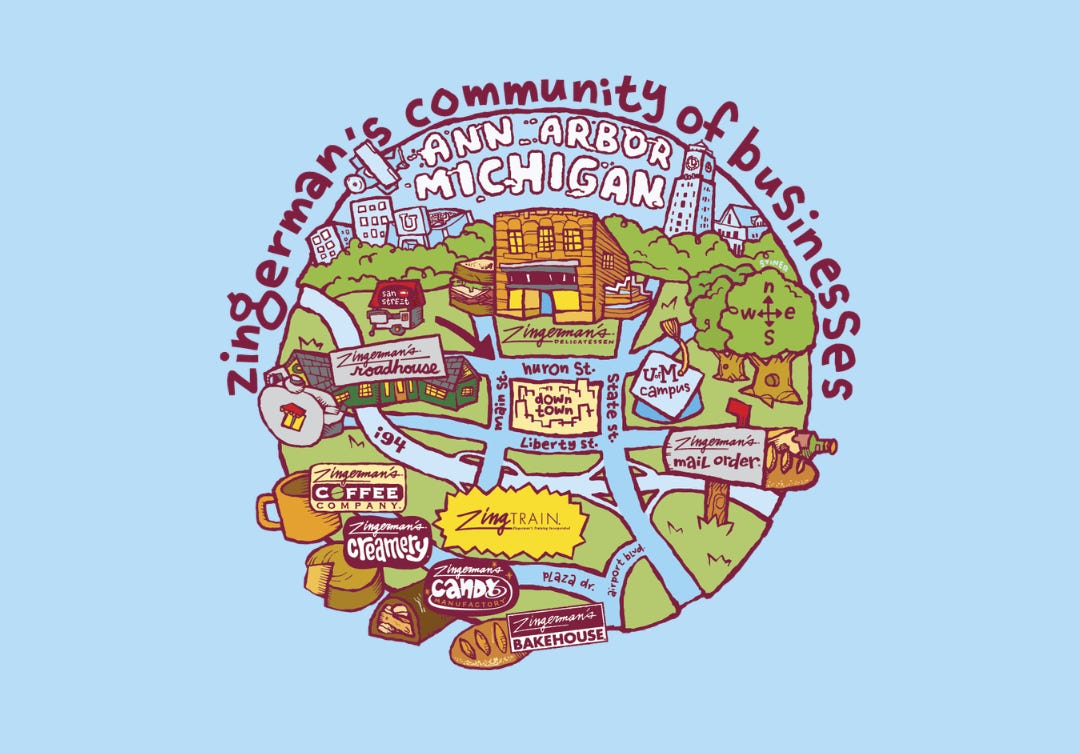
Zingerman’s fancies itself a “community of businesses” of a dozen-plus, including a farm, a creamery, a bakehouse, a candy company, a mail-order house, a training company, and all kinds of restaurants. All Zingermans’ enterprises are locally owned, share branding and business services, and collectively employ more than 700 people (1,000 in the peak month of December).
The two founders, Paul Saginaw and Ari Weinzweig, decided the best way to preserve their life’s work and the company’s mission—great food, great jobs, great community service—was to put the entire enterprise into a trust. So in 2023, they launched a new, innovative entity called the Zingerman’s Perpetual Purpose Trust (ZPPT). Paul and Ari appointed the trustees, and gradually, their ownership will be bought out. The trust guarantees employees’ profit sharing in perpetuity.
Our first article in this week’s issue of The Main Street Journal is Ari’s reflections on the ZPPT—its origins, its design, and its results thus far. There are several dozen of these trusts operating in the United States, the best known being Patagonia. Many see this as providing an easy way to benefit employees, without the expense of creating an employee stock ownership plan (ESOP) or the complexity of creating a worker cooperative.
Our second article tracks the progress of PPTs in the United Kingdom, where they are now the dominant form of empowering employees. With the support of all major political parties, the UK Employee Ownership Trust Act was passed in 2014. Originally, companies received handsome tax benefits if they converted into trusts. Business owners who sold the company got a 100% tax exemption on capital gains, and employees were able to receive tax-free bonuses of up to 3,600 pounds ($4,805) per year. By 2024, nearly one in ten business transfers in the country were using this law, and 2,500 businesses had become EOTs, benefiting about 350,000 UK employees. The new Labor government, however, has controversially cut back on these incentives, and the conversion rate has plummeted.
Our third article offers a huge footnote to the EOT movement in the United States. Many EOTs have been created by private equity (PE) firms, which are best known for buying up weak businesses, loading them up with debt, decimating staff, and then reselling the moribund company for a quick buck. One study, from California Polytechnic State University in 2019, found that PE-bought companies went bankrupt at ten times the rate of equivalent publicly traded companies. A few PE firms have tried to improve their public image by creating EOTs, but—surprise!—they snatch more of the gains from workers than other worker-ownership conversions would.
Finally, I’ll mention that my colleagues and I in the Bard Green MBA Program created a consulting firm called the Big Innovations Group Cooperative (BIG), run by students and alumni. It’s structured as a worker co-op (I’m a member, and in its first six months of operation, BIG has booked more than $100,000 in business). It just completed a report entitled “Sustainability Hiring in a Time of Transition,” which shows that sustainability-related skills are still needed and job opportunities are still opening up, despite the Trump Administration’s hostility toward ESG (environmental, social, and governance) standards. The report is well worth a look.
— Michael Shuman, Publisher
Publication of The Main Street Journal depends on your support. If you like what you’re reading, please consider becoming a paid subscriber today. Paid subscribers can attend our monthly “Mondays with Michael” and receive a free consult on their projects.
NEWS
A Positive Look at Perpetual Purpose Trusts (Zingerman’s Community of Businesses, March 11) offers a sneak peek at Ari Weinzweig’s new book, Why Democracy Matters.
Business Transfers to Employees in Great Britain Abruptly Stop (European Federation of Employee Share Ownership, March 2) as the UK government cut the tax exemption for business transfers to employees.
In Sharing Wealth With Workers Creates Value for Private Equity Buyout Firms (ImpactAlpha, March 3), writer Roodgally Senatus asks, “So, why not share more?”
The Story of Demise: California’s Redevelopment Agencies (Next City, February 27) distills the history of the state’s redevelopment agencies (RDAs), independent entities created by local governments to counter economic blight. Despite failures, RDAs’ demise left a vacuum in public land stewardship and investment in local economic and real estate development.
Introducing Don Morgan, Public Banking’s New Champion (Ellen Brown, February 25) and President of the Bank of North Dakota. Stay tuned for a future interview with Don in an upcoming MSJ Extra!

SPONSOR CORNER
The National Coalition for Community Capital (NC3) is dedicated to educating, advocating, and activating community capital and serves as MSJ’s fiscal sponsor. Thank you for being a part of a growing movement! Contact NC3 for support in integrating local investing in your work: info@nc3now.org.
NC3 UPDATES AND ANNOUNCEMENTS
NC3 is excited to participate in the Just Economy Conference on April 14–15 in Washington, DC. We will be sharing real-world experiences from two community leaders who have worked with us to co-create Diversified Community Investment Funds. They are both now raising capital from everyone in their communities, in particular embracing first-time ‘retail’ investors who’ve long been excluded from investing in their own communities.
Joining us in the conversation are Jessica David from the Rhode Island Community Investment Cooperative and Brent Forsberg of the Lansing Growth Fund in Michigan. Brett Theodos from The Urban Institute, Lead for Urban’s New Center for Local Finance and Growth, will provide us with a big picture research and efficacy perspective on these funds.
Looking forward to joining more than 1,200 practitioners working to advance a more inclusive economy. #JustEconomyConference #CommunityCapital #InclusiveEconomy #NC3
PARTNER NEWS & VOICES
How Employee Ownership Expands a Fractional CFO’s Value, Project Equity (March 12)
A New Strategic Vision to Ensure Great Public Spaces Are Never the Exception, Project for Public Places (March 11)
Why Do Economic Justice Solutions Work? Neighborhood Economics (March 9)
Here Comes the Sun, Abrams+Angell (March 6)
The Evolution of Place-Led Development, Village Well (March 5)
Scale Has Outpaced Accountability, Local Futures (March 3)
Why I Keep Coming Back to Ownership, Ownership Capital Lab (February 23)
NOTABLE NEW RESOURCES
Certified EO Launches EO Base to Close the Participation Gap Undermining Employee-Owned Companies, Business Wire (March 4)
Southern Edition: Co-op Atlas, JNF Digital (February 26)
Employee Ownership Initiative Report, US Department of Labor (February 20)
EVENTS
Planet Local Sharing Circle - Virtual Event: March 25, at 11 am ET
Succession Planning Through Employee Ownership - Virtual Event: March 26, at 2 pm ET
How Better Data Can Accelerate Shared Equity Housing - Virtual Event: March 27, at 2 pm ET
Move Your Money Month: Bank Local, Invest Local - April 1 - 30
The Living Systems Summit: From Doughnuts to Deep Roots - In-Person Event (Okotoks, Alberta): April 13 - 15 (Virtual option also available)
Accelerating the Transition 2026 - In-Person Event (San Francisco, CA): April 18 - 20 (Virtual option also available)
Connecting for the Common Good - In-Person Event (Cincinnati, OH): May 4 - 6
JOBS BOARD
Chicago TREND: Vice President, Advisory Services
ImpactAlpha: Edge – Data Fellow
New Majority Capital: Community Manager
About The Main Street Journal
The Main Street Journal aims to catalyze the movement of $50 trillion from Wall Street to Main Street, facilitating economic development and economic justice. It’s sponsored by the National Coalition for Community Capital, with grants from the Heron Foundation, Wallace Global Foundation, and the Bondi Foundation. We welcome feedback about everything, from our design to our content. Please send ideas to Jen Risley at jen@main-street-journal.com.
Our Team:
Michael Shuman – MSJ Publisher
Paul Spinrad - Decent Tuesday Writer & Editor
Jen Risley - MSJ Editor
Wendy Wasserman - Strategic Advisor
PARTNERS
Abrams+Angell | American Independent Business Alliance | American Sustainable Business Network | Candide Group | Capital for Change | Capital Institute | Community-Vision Solutions | Cordata Capital | Council Fire | Crowdfund Better | Crowdfund Capital Advisors | Democracy Collaborative | Eleanor LeCain | Exit to Community Collective | Fair Food Network | Future Roots | Garlic and Roses | Impact Finance Center | ImpactPHL | Initiative for Local Capital | Institute for Local Self-Reliance | The Kassan Group |Longfellow Health Clubs | Mission Driven Finance | National Coalition for Community Capital | Natural Investments | Neighborhood Associates | Neighborhood Economics | New Majority Capital | Next Egg | Nonprofit Quarterly | Ownership America | Ownership Capital Lab | Ownership Matters | Partnership for Southern Equity | PathLight Law | Project Equity | Project for Public Spaces | Prospera Partners | Raise Green | Revalue | Rising Tide Capital | Schumacher Center for a New Economics | Shelterforce | Slow Money | SOCAP | The Super Crowd Inc. | Sustainable Business Network of MA | Transform Finance | Uwharrie Bank | Village Well | Zebras Unite
We welcome any nonprofit or for-profit entity committed to local investment as a partner. If your organization is interested, please contact Jen Risley at jen@main-street-journal.com.
Thank you Michael. You note "Our third article offers a huge footnote to the EOT movement in the United States. Many EOTs have been created by private equity (PE) firms, which are best known for buying up weak businesses, loading them up with debt, decimating staff, and then reselling the moribund company for a quick buck."
Yet the third article you shared ("Sharing Wealth With Workers Creates Value for Private Equity Buyout Firms") offers no examples of this. I am curious who/what you are talking about specifically?